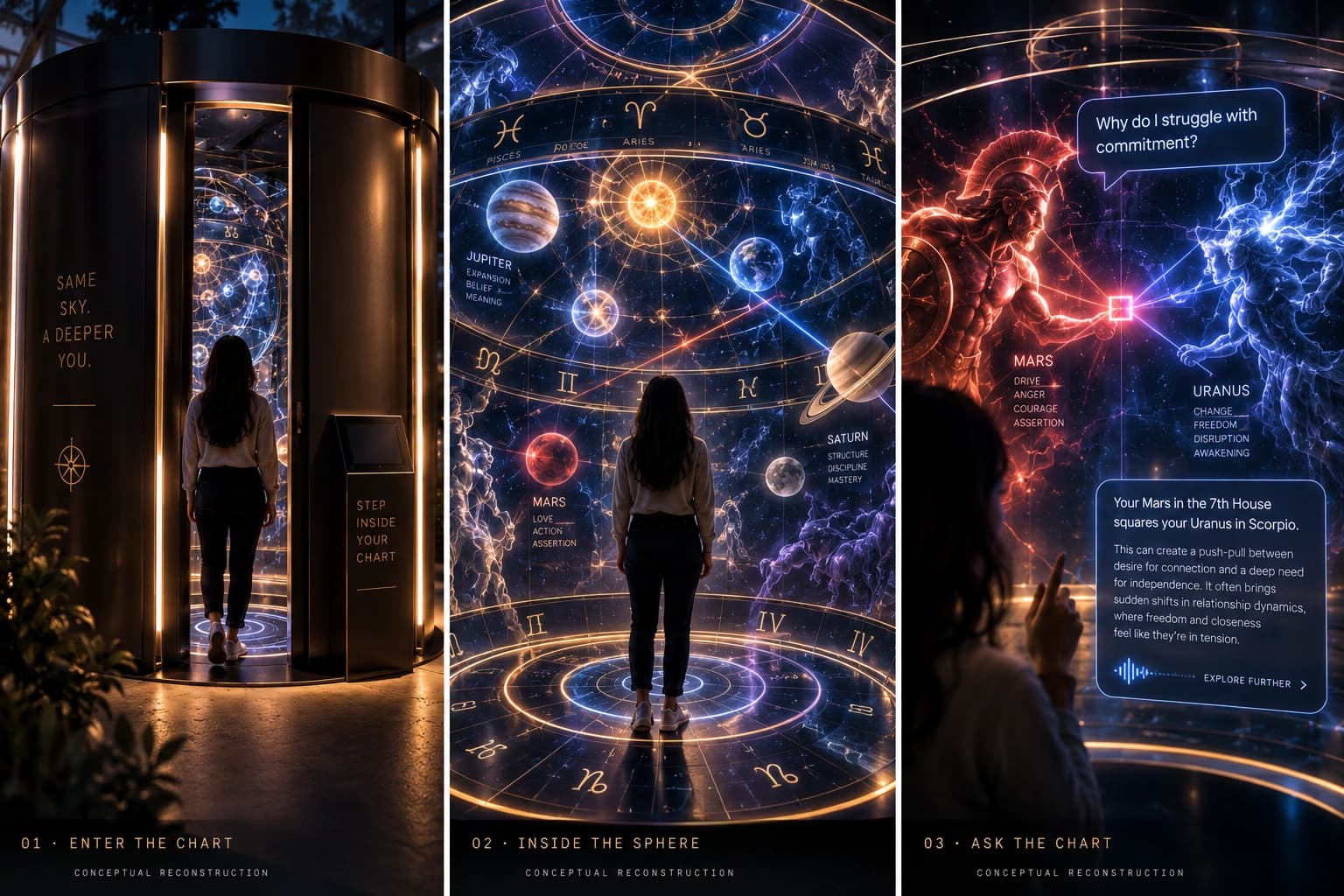
Create a private threshold
Use a semi-private booth to signal that the experience is personal, contained, and meant for focused exploration.
IMAGINE
Immersive Introspection
THE SITUATION
Astrological Birth charts compress an enormous amount of symbolic information into a static circular diagram: planets, signs, houses, aspects, angles, motion, and archetypal relationships.
To an experienced astrologer, that compression is efficient. To most other people, it can feel like cosmic algebra.
The person has to translate glyphs into meaning, imagine spatial relationships from a flat wheel, understand tension and harmony from thin lines, and interpret an intensely personal system through a format optimized for expert literacy.
The problem isn't a lack of information. It's the distance between the information and the person trying to understand it.
THE PROVOCATION
Instead of asking someone to decode a two-dimensional wheel, the concept turns the chart into a semi-private immersive space.
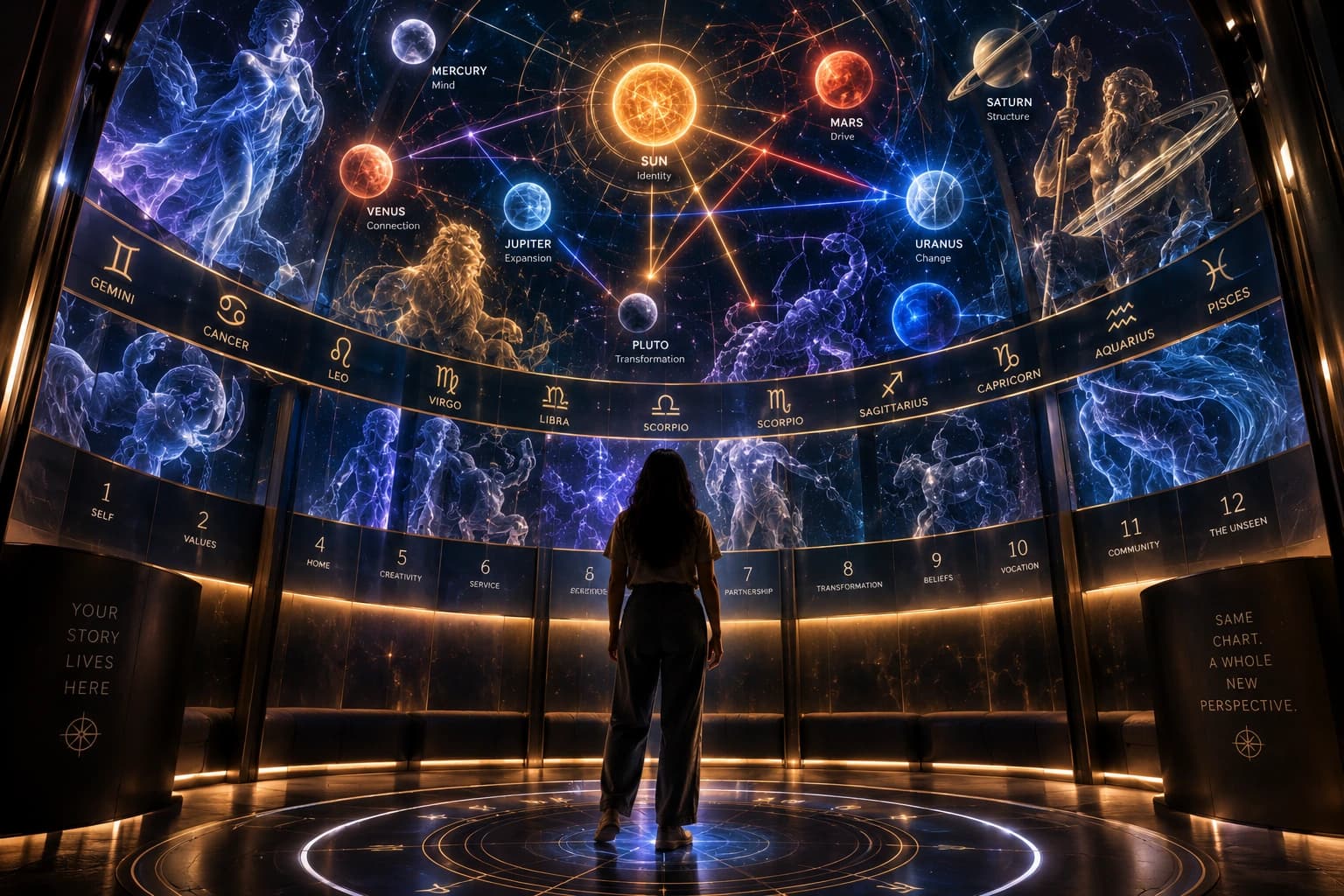
The person steps onto a central platform. A full-scale holographic armillary sphere resolves around them. Signs, houses, planets, motion, and aspects occupy space in 360 degrees.
The body becomes the orientation point.
THE INTERVENTION
The concept uses spatial immersion, archetypal storytelling, and conversational intelligence to transform a symbolic chart into something a person can physically explore.
Use a semi-private booth to signal that the experience is personal, contained, and meant for focused exploration.
Place the user inside a full-scale armillary sphere so the chart becomes spatial rather than flat.
Show planetary motion, speed, aspect relationships, and changing emphasis through light, movement, and spatial animation.
Let the person ask questions and receive explanations through spoken guidance plus visual demonstrations inside the chart.
INSIDE THE SYSTEM
In the chamber, the chart surrounds the visitor. Zodiac bands, houses, planets, and aspect relationships are no longer symbols competing for attention on a page. They exist around the person as a navigable structure.
Looking up, behind, across, or through the sphere creates a different kind of understanding. Relationships become positional, not merely diagrammatic.
MAKE THE ABSTRACT LEGIBLE
Astrology is full of abstract relationships. A square, opposition, conjunction, or trine carries meaning, but those relationships can remain difficult to grasp when represented as geometry alone.
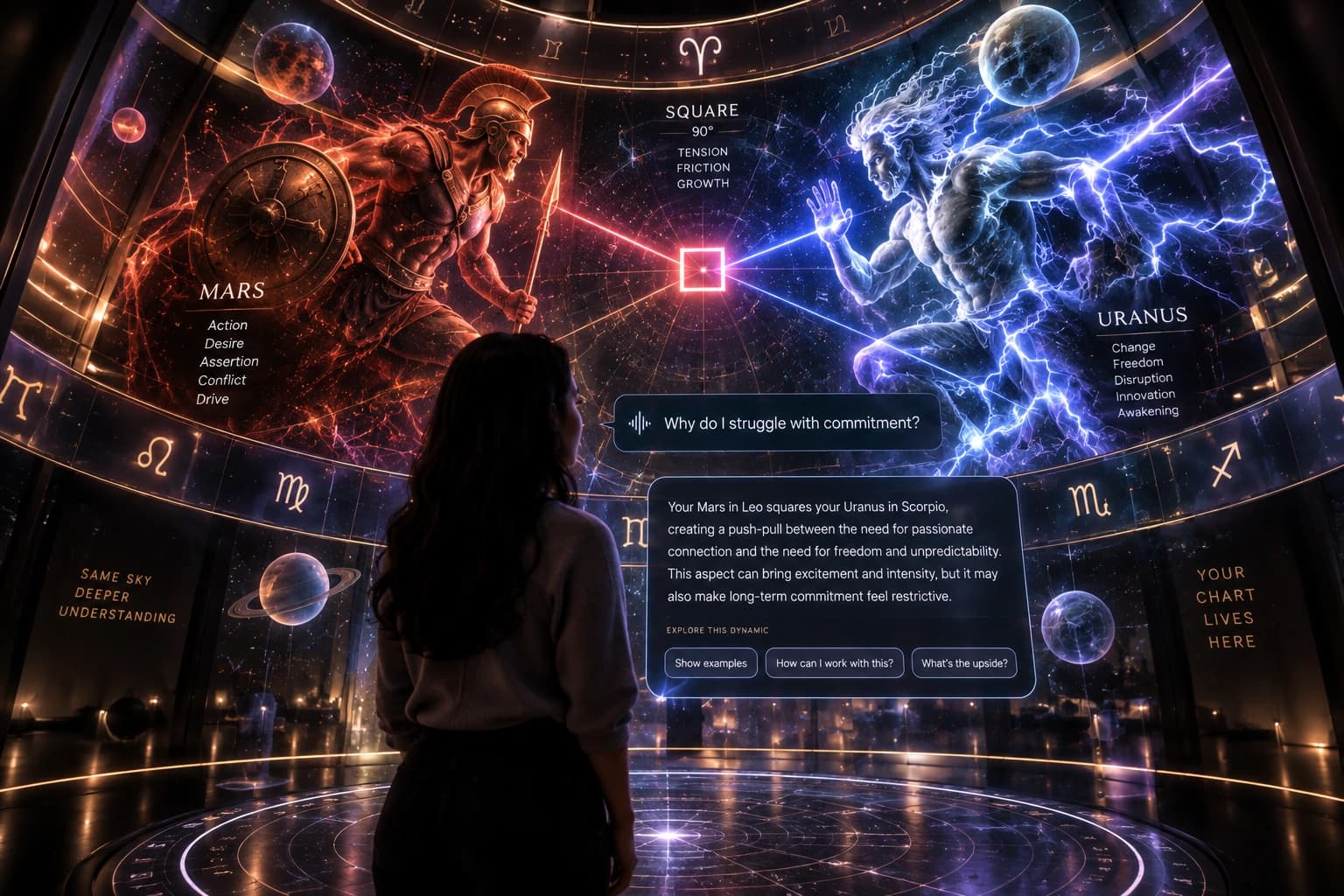
In this concept, archetypal planetary figures embody those relationships. Aspect beams use color and intensity to distinguish tension, harmony, friction, and flow.
Mars and Uranus do not simply sit at a 90-degree angle. They can visually confront one another, each asserting a different kind of force.

ASK THE CHART
The intelligence layer allows the visitor to ask natural-language questions about their chart rather than knowing which symbols to investigate first.
The response is not only verbal. The relevant planets, houses, aspects, and archetypal figures activate around the person to demonstrate the interpretation visually.
Interpretation becomes something you can watch happen around you.
DESIGN FOR VULNERABILITY
The booth is not decorative. It is a privacy decision.
Birth charts can surface deeply personal questions about identity, relationships, fear, ambition, family, intimacy, and change. An experience built around that kind of inquiry should not feel like a public kiosk with strangers standing behind you.
The chamber creates enough separation to make exploration feel personal without turning the experience into total isolation.
MY ROLE
I defined the problem, shaped the spatial concept, designed the visitor journey, established the privacy model, translated the birth chart into an immersive armillary structure, and imagined how conversational intelligence could activate visual interpretation.
The work is intentionally conceptual. Its purpose is to make the experience legible enough that it can be discussed, challenged, and eventually prototyped.
WHAT THE CONCEPT DEMONSTRATES
The concept explores how spatial immersion could reduce the cognitive barrier to understanding a complex symbolic system.
It also treats interpretation as an experiential act: something visual, embodied, responsive, and emotionally resonant rather than purely explanatory.
Most importantly, it suggests that privacy, atmosphere, and interaction are not secondary layers. They are part of making the system understandable.
THE TRANSFERABLE PRINCIPLE
Abstraction creates efficiency for experts, but distance for everyone else.
Sometimes the most useful interface is not another screen. It is an environment.