Find the translation gap
Identify what the coach understands from above that the player must somehow reconstruct from ground level.
ENVISION
Coach Vision
THE SITUATION
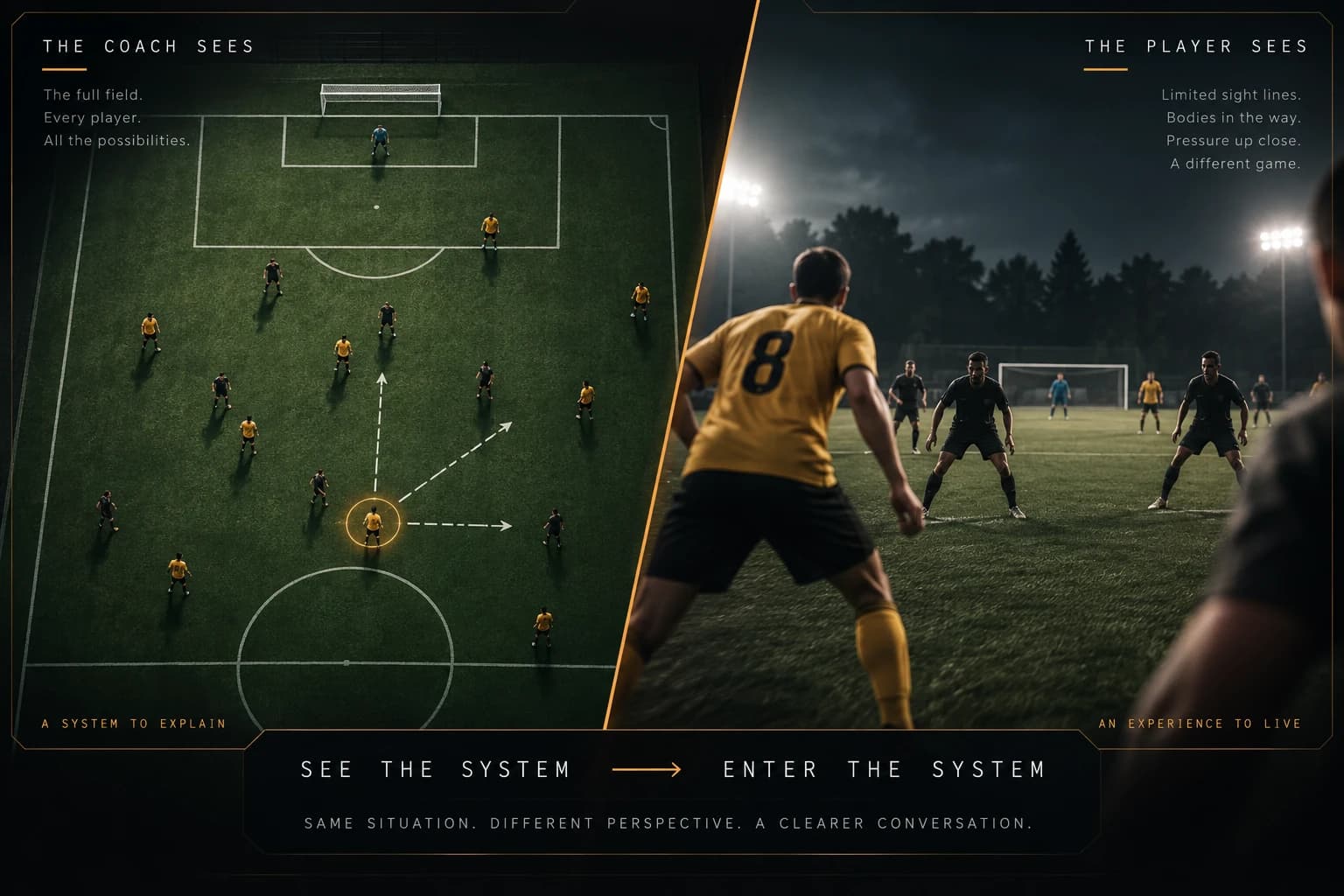
Soccer strategy is typically explained from above: magnetic boards, marker drawings, tokens, tactical diagrams, and animated formations. That perspective is useful because a coach is mentally tracking the entire system at once.
The player experiences something completely different. Bodies block sight lines. Pressure closes space. Distances feel different from ground level. Passing lanes appear and disappear. Information is partial, moving, and constantly changing.
The coach sees the system. The player experiences it from inside.
THE PROVOCATION
A professional soccer coach developed a robust curriculum to improve coaching quality in the U.S. But while tactics are traditionally taught through drills and repetition on the field, the classroom experience had been largely overlooked.
Like many team sports, soccer strategy was taught from a top-down perspective, with players then expected to mentally translate diagrams on a board into what they would actually see, feel, and do on the field.
Could a coach move from explaining where a player should be to showing what that player might actually see?
THE INTERVENTION
The concept depended on connecting two representations of the same tactical moment: the coach's system-level view and the player's embodied view from inside it... at the same time.
Identify what the coach understands from above that the player must somehow reconstruct from ground level.
Keep the tactical situation intact, but move the viewpoint into the position of the player experiencing it.
Learn enough 3D modeling and development from scratch to make the idea tangible instead of leaving it as a sketch.
Build a functioning prototype that could move between tactical overview and player perspective seamlessly.
BUILD THE CAPABILITY
The concept required a manipulable 3D environment, and I had never built one.
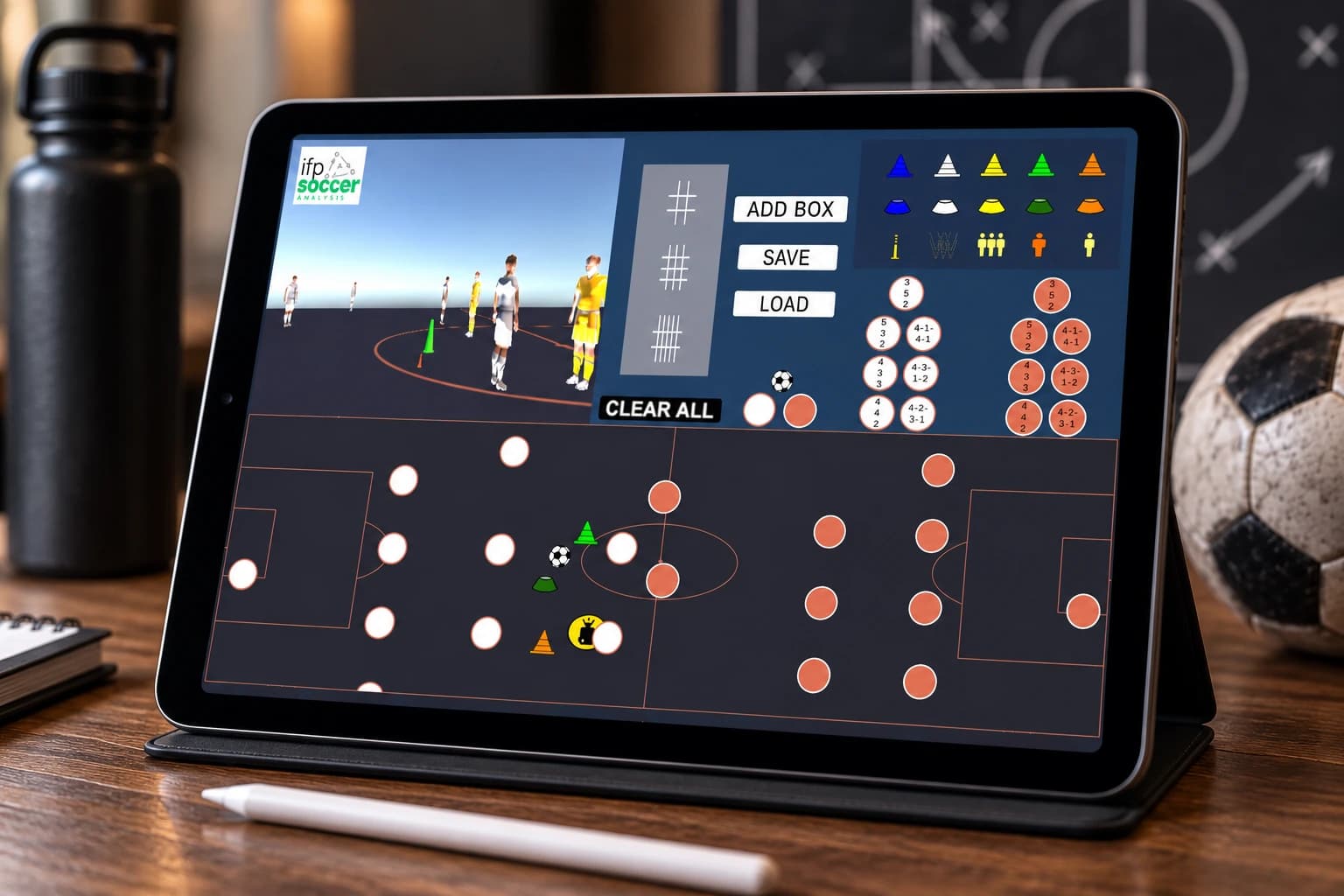
So I learned enough 3D modeling and development from scratch to create the field, player models, tactical objects, formations, saved states, controls, and a movable ground-level viewpoint.
The prototype wasn't a product. It was a functioning question.
ENTER THE SYSTEM
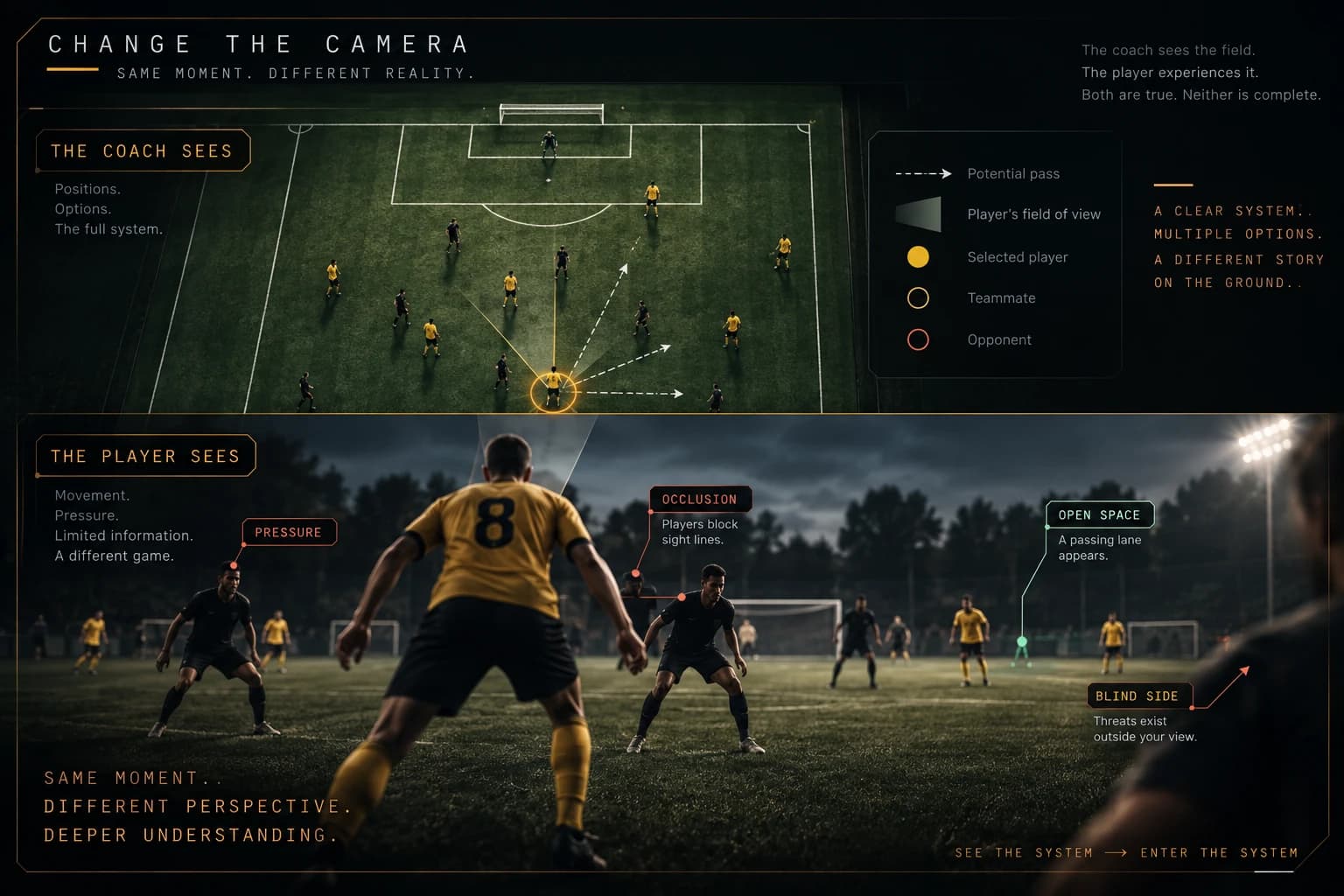
From above, positioning and options can appear obvious. From inside the field, bodies create occlusion, opponents create pressure, teammates move in and out of view, and open space only exists from certain angles.
The prototype explored whether moving between those two viewpoints could make the coach's explanation easier for a player to inhabit rather than merely remember.
MY ROLE
I identified the communication problem, shaped the concept, defined the interaction between coach and player perspectives, taught myself the 3D tools required to prototype it, and built enough of the experience to make the idea observable.
The value of the work was not polished software. It was turning an abstract question about perspective into something that could be seen, manipulated, and discussed.
WHAT HAPPENED
The experiment demonstrated a workable way to connect a traditional tactical overview with the viewpoint of the player occupying that system.
More importantly, it clarified the larger design question behind the prototype: people are often asked to understand systems through representations optimized for the expert explaining them, not for the person actually experiencing them.
THE TRANSFERABLE PRINCIPLE
Expert representations are useful, but they are never neutral. Understanding changes with position, context, visibility, and experience.
Sometimes the most useful design move is not adding more information. It is changing the point of view.